Dr Kon Kam King Nicolas
Neurosurgeon


Source: Getty Images
Neurosurgeon
We have all likely experienced a headache at some point – some of us may even experience migraines, or tension headaches occasionally. While these episodes can last from hours to days, feel very painful and affect your daily life, they do not usually point toward a severe underlying issue, such as a brain tumour.
Frequently, a headache caused by a brain tumour has different characteristics compared to other types of headaches. And often, patients with brain tumours have more symptoms than just a headache.
A brain tumour is the abnormal growth of cells in the brain or central nervous system. Brain tumours vary in their nature, ranging from benign (non-cancerous) tumours, which grow slowly and are less likely to recur, to malignant (cancerous) tumours, which can proliferate and invade surrounding tissue.
A headache stemming from a brain tumour can present as a persistent and progressively worsening pain.
Unlike tension headaches that might be triggered by stress, or migraines that might be associated with certain foods or sounds, these headaches do not have the same triggers. They also worsen with activities that increase the pressure inside the head, like bending over, lifting heavy objects, or sudden movements.
Often, a headache brought on by a brain tumour is generally more severe upon waking in the morning and may improve throughout the day. This can be attributed to the body's position during sleep, which can result in increased pressure inside the brain, leading to heightened pain upon awakening.
It is important to note that brain tumour headaches tend to intensify over time. As the tumour grows, more pressure is exerted on the surrounding brain tissues, leading to escalating discomfort.
There are some distinctions between a headache caused by a brain tumour and those caused by tension headache or a migraine. These differences can be broadly categorised by their origin and nature of pain, their accompanying symptoms, and their triggers and duration. Understanding the distinctions between these types of headaches is important, and can alert you when you might require a doctor to take a closer look. We’ve condensed the most relevant distinctions between the 3 types of headaches in the table below.
| Key differentiators | Brain tumour headache | Migraine | Tension headache |
|---|---|---|---|
| Location of pain | The pain can feel like it's not confined to a specific area of the head, though a neurosurgeon can help pinpoint the location. | Pain is often located on one side of the head. | Pain often begins in the forehead, the back of the head, or around the neck. |
| Nature of pain | Non-specific and dull initially, and may become more severe and persistent over time. | - A throbbing or pulsating pain. - May be preceded by an “aura”, which is a type of sensory warning. |
- Constant dull and aching sensation. - Pain can feel like a tight band around the forehead or at the back of the head |
| Accompanying symptoms | - Nausea and vomiting (especially in the morning) - Blurred or double vision - Balance problems - Seizures - Personality or behaviour changes - Weakness or numbness in parts of the body |
- Sensitivity to light and noise - Nausea and vomiting - Loss of appetite - Upset stomach or abdominal pain |
- Usually not accompanied by other symptoms, although some people might experience sensitivity to light, similar to a migraine |
| Triggers | Usually gets worse with activities that increase pressure inside the head | - Certain foods - Alcohol - Stress - Changes in sleep patterns - Certain smells |
- Stress - Fatigue - Poor posture |
| Duration | Often worse in the morning and might decrease throughout the day. Tends to get more frequent and severe as the tumour grows. | - Can last from a few hours to several days - Comes in episodes and is usually not constant |
Can last anywhere from 30 minutes to a week. May persist for longer in chronic cases |
To understand other types of headaches, visit our page here. If you are unsure about the type of headache you are experiencing, consult your doctor.
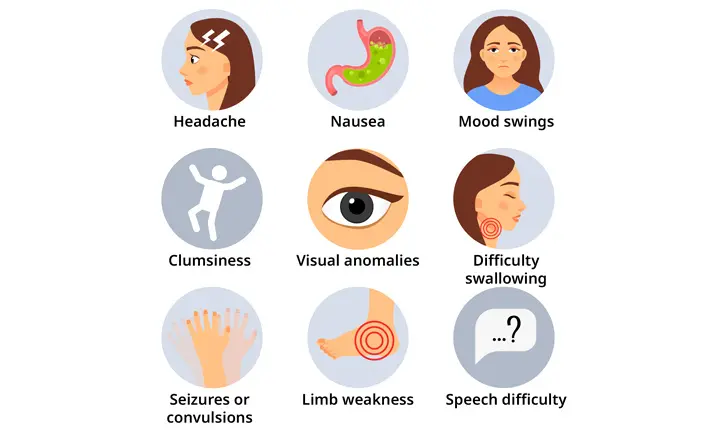
Brain tumours can cause an array of neurological symptoms that reflect the area of the brain that's affected. These symptoms can vary widely in their nature and severity, but there are several common signs to be aware of. Some of these include:
You can take a closer look at other symptoms of brain tumours here. Fortunately, brain tumours are treatable with the right approach.
Brain tumours are treated through a personalised, patient-centred approach. Treatment plans are carefully developed based on key factors such as the tumour’s type, size, and location, as well as the patient’s age and overall health. The main aim is to effectively control or remove the tumour while preserving surrounding healthy brain tissue.
Surgical intervention is the first line of treatment when the tumour is amenable to safe removal. With the help of advanced approaches such asminimally invasive surgery, real-time imaging and neuro-navigation systems, a precise operation can be performed to remove the tumour fully. For some patients, awake brain surgery with brain mapping can also be beneficial when the tumour is encroaching on healthy brain tissue.
For tumours located in challenging locations or those which cannot be entirely removed surgically, radiotherapy comes into play. Radiotherapy employs high-energy radiation to eliminate tumour cells. Further, chemotherapeutic drugs are often used in combination with surgery and radiotherapy for types of tumours that respond well to such treatments.
Emerging approaches like immunotherapies and precision therapies also form a part of the therapeutic arsenal against brain tumours. Immunotherapies seek to empower the body's immune system to combat cancer cells, whereas precision therapies target the unique biological attributes of the tumour cells.
It should be noted that this isn’t the full spectrum of treatments available for brain tumours, and appropriate treatment options are always best proposed by your doctor.
While the chance your headache is a sign of a brain tumour is slim, if you have persistent or unusual headaches, it’s crucial that you seek professional medical advice from a neurosurgeon, who will be able to diagnose and treat your condition by designing a thorough treatment plan and offering consistent support and aftercare throughout your path to recovery.
When it comes to your brain and nervous system, even small symptoms can feel overwhelming. At Mount Elizabeth Hospital, you don’t have to navigate them alone. Our experienced neurosurgeons are here to listen, assess, and guide you towards the right care — helping you take control of your health with confidence.
Find a specialist
A monthly breast self-examination 7 – 10 days after your period starts can save your life.

More women are being claimed by breast cancer now than before. Love them by encouraging them to go for breast screening.

Dr Tan Yah Yuen, general surgeon at Mount Elizabeth Hospitals, answers the questions you may have about mastectomies.

Dr Wee Siew Bock, breast surgeon at Mount Elizabeth Hospital, address your questions and concerns about breast conserving surgery (lumpectomy).

Dr Tan Yu-Meng, general surgeon at Mount Elizabeth Hospitals, gives us the stark facts about pancreatic cancer and the treatment options available for patients.

Ovarian cancer has been dubbed a silent killer as it often presents at a late stage, resulting in low survival rates. Dr Elisa Koh explains the current statistics and treatment methods for ovarian cancer.
Parkway East Hospital is part of IHH Healthcare, one of the world’s largest integrated healthcare networks.

Download the MyHealth360 app to access an array of medical services conveniently.


Get trusted medical advice from our specialists, dietitians and physiotherapists directly in your inbox.
Subscribe