


Dr Tan Yung Khan
Urologist


 Add as a preferred source on Google
Urologist
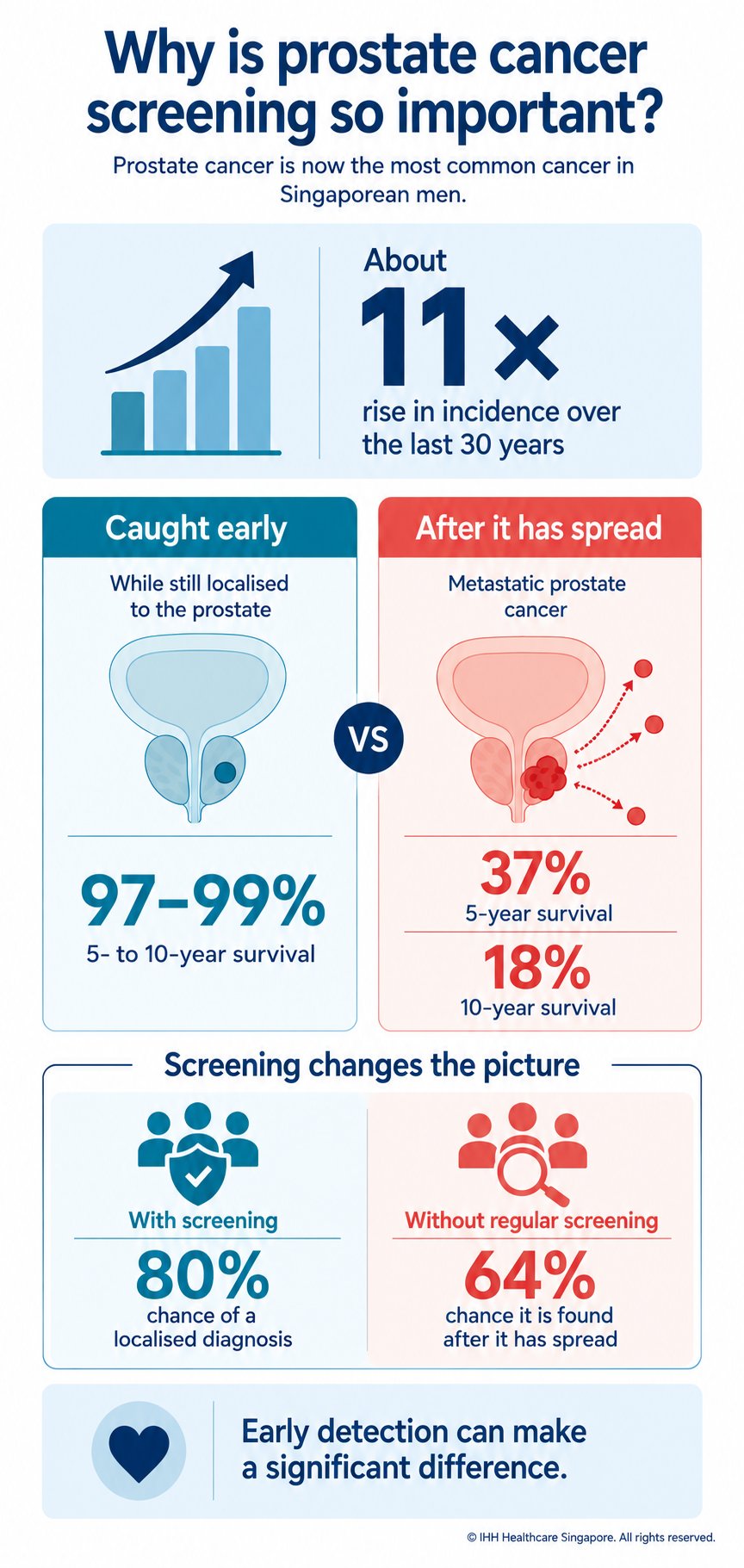
Prostate cancer is the most common cancer among men in Singapore – accounting for 18% of all male cancer diagnoses between 2019 and 2023, according to the Singapore Cancer Registry Annual Report 2023.
Yet despite its prevalence, around 30% of cases are still diagnosed at stage 4, when the cancer has already spread. The difference between those outcomes comes down largely to one thing: whether the cancer was caught early.
Urologist Dr Tan Yung Khan walks through what prostate cancer screening involves, what happens when something is found, and what treatment options are available today.
Prostate cancer incidence in Singapore has risen approximately 11-fold over the last 30 years – and it is now the most common cancer in Singaporean men.
The good news is that when it is caught early, while still localised to the prostate, the 5- to 10-year survival rate is between 97% and 99%. Essentially, if you are diagnosed at this stage, you are very unlikely to die from prostate cancer anytime soon.
The picture changes dramatically once the cancer has spread. For metastatic prostate cancer – where the cancer has moved beyond the prostate – the 5-year survival rate drops to around 37%, and at 10 years, it falls further to around 18%. And these are 2025 figures, after newer drugs have already improved outcomes.
The case for catching it early is clear: screening gives an 80% chance of a localised diagnosis. Without regular screening, there is a 64% chance the cancer is only found after it has already spread.
Generally, we recommend starting PSA screening from the age of 50, done yearly or every two years. Some corporate health screenings test earlier than this, which can sometimes lead to confusion – so it is worth discussing with your doctor what is appropriate for your age and situation.
If there is a family history of prostate cancer, we would suggest starting earlier, at 45.
And increasingly, we recognise that family history of other cancers e.g. breast cancer, pancreatic cancer, gastric cancer, can also signal a genetic predisposition to prostate cancer. So, if those cancers run in your family, that is also a reason to have an earlier conversation with your doctor about screening.
PSA stands for prostate specific antigen – a protein produced by the prostate gland. The blood test is simple, but an elevated result does not automatically mean cancer. It means the risk has gone up, and further investigation is warranted.
The next step is usually a more sensitive blood test called the Prostate Health Index, or PHI, which gives us a better signal of whether cancer is likely. From there, we would typically recommend an MRI of the prostate. This allows us to look at the prostate in detail and identify any areas that appear abnormal before we consider a biopsy. The days of an elevated PSA automatically leading straight to a biopsy are largely behind us.
When I was a trainee, an elevated PSA meant an immediate biopsy – and it was what we call a systematic biopsy: we divided the prostate into zones and took a sample from each one, essentially hoping we would hit the cancer. It was, as I sometimes describe it, a tikam tikam approach – you may or may not find what you are looking for.
Today, we use MRI to identify the specific area that looks suspicious, and then use a targeted biopsy system to precisely sample that area. This gives us a much more accurate diagnosis. We have also changed the approach to how we physically perform the biopsy. The older method – a transrectal biopsy, where a needle passes through the rectal wall – carries a real risk of serious infection. We have had patients in the past who died from biopsy-related infections.
Today, we use a transperineal approach: the biopsy is taken through the skin between the rectum and the scrotum, which can be properly cleaned and sterilised. We rarely need to give antibiotics beforehand, and the infection rate is now very low.
In a private setting, we typically perform biopsies under light sedation – patients are comfortable throughout, and many wake up saying they slept better than they had in years.
Pain after the procedure is generally minimal; I no longer routinely prescribe even paracetamol to my patients post-biopsy. The main side effects are some blood in the urine for a couple of days, and sometimes blood in the semen, but both resolve on their own.
The risk profile of a modern transperineal biopsy is significantly better than older techniques. When performed properly, it is a safe and well-tolerated procedure.
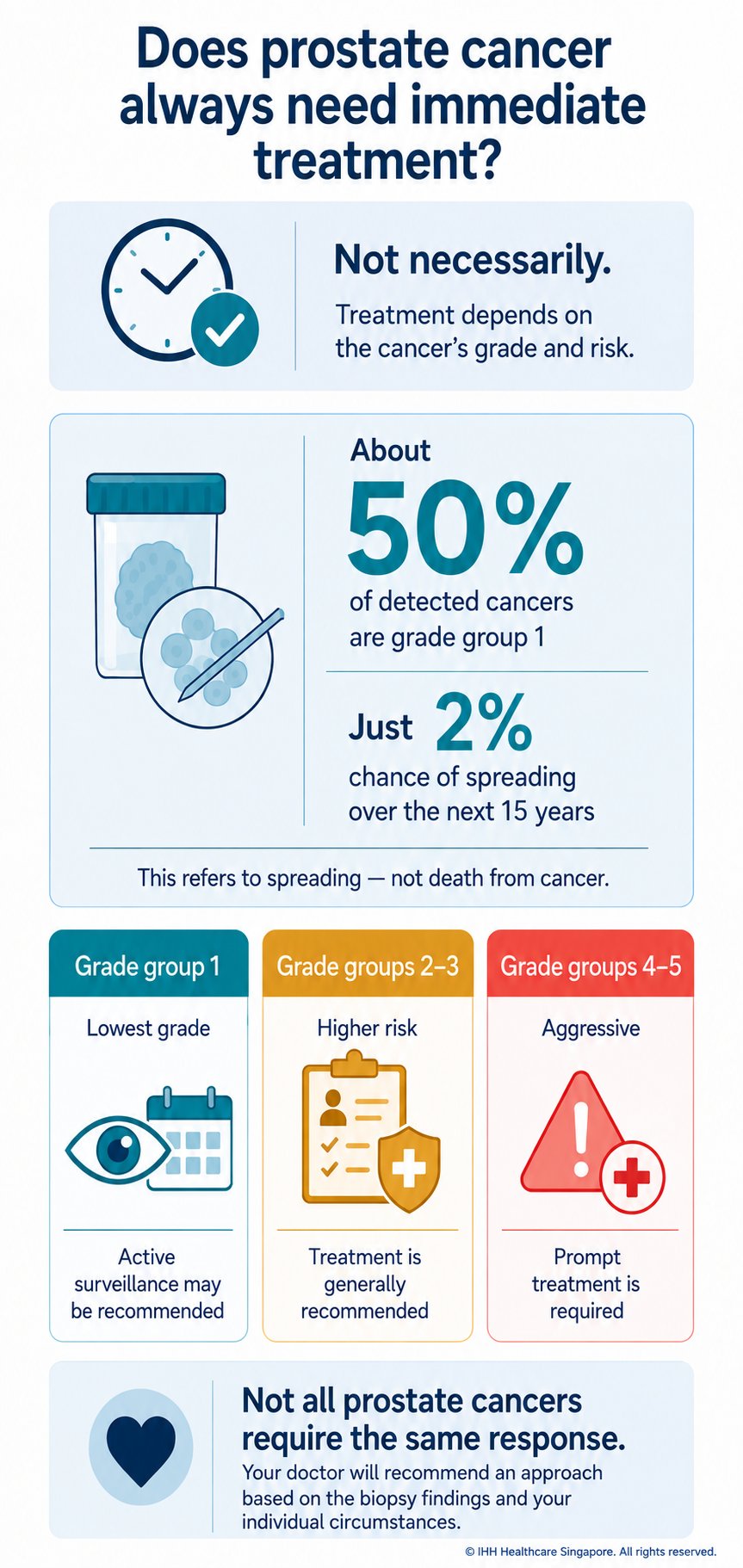
Not necessarily – and this is one of the most important things to understand about how prostate cancer management has evolved.
When we look at the biopsy results, we grade the cancer. About 50% of cancers we detect fall into what we call grade group 1 – the lowest grade. For these cancers, the chance of spreading over the next 15 years is just 2%. Not death from cancer – just spreading. That is a very low risk.
For grade group 1 cancers, particularly when they are a small focus, we often recommend active surveillance rather than immediate treatment.
The reason this matter is that in the past, over-treatment was a real problem – anyone diagnosed with prostate cancer was sent straight to surgery or radiation, leading to unnecessary side effects like urinary incontinence and erectile dysfunction.
We now know that not all cancers require the same response. Grade group 2 and 3 cancers carry higher risk and we would recommend intervention. Grades 4 and 5 are aggressive and require prompt treatment.
Speak to a prostate cancer specialist to understand more about your condition and treatment options.
Active surveillance means we monitor the cancer closely rather than treating it immediately. For a low-grade, localised cancer – particularly a small grade group 1 – this is a very reasonable approach. It involves regular PSA blood tests, periodic MRI scans, and sometimes a repeat biopsy to make sure the cancer has not changed character.
It is important to understand that active surveillance is not the same as doing nothing. It is a structured, protocol-driven programme of monitoring. Patients cannot simply decide to stop attending follow-up because they feel well – prostate cancer can be multifocal, meaning it can appear in more than one part of the prostate, either simultaneously or over time. Missing a follow-up appointment could mean missing a change that requires action.
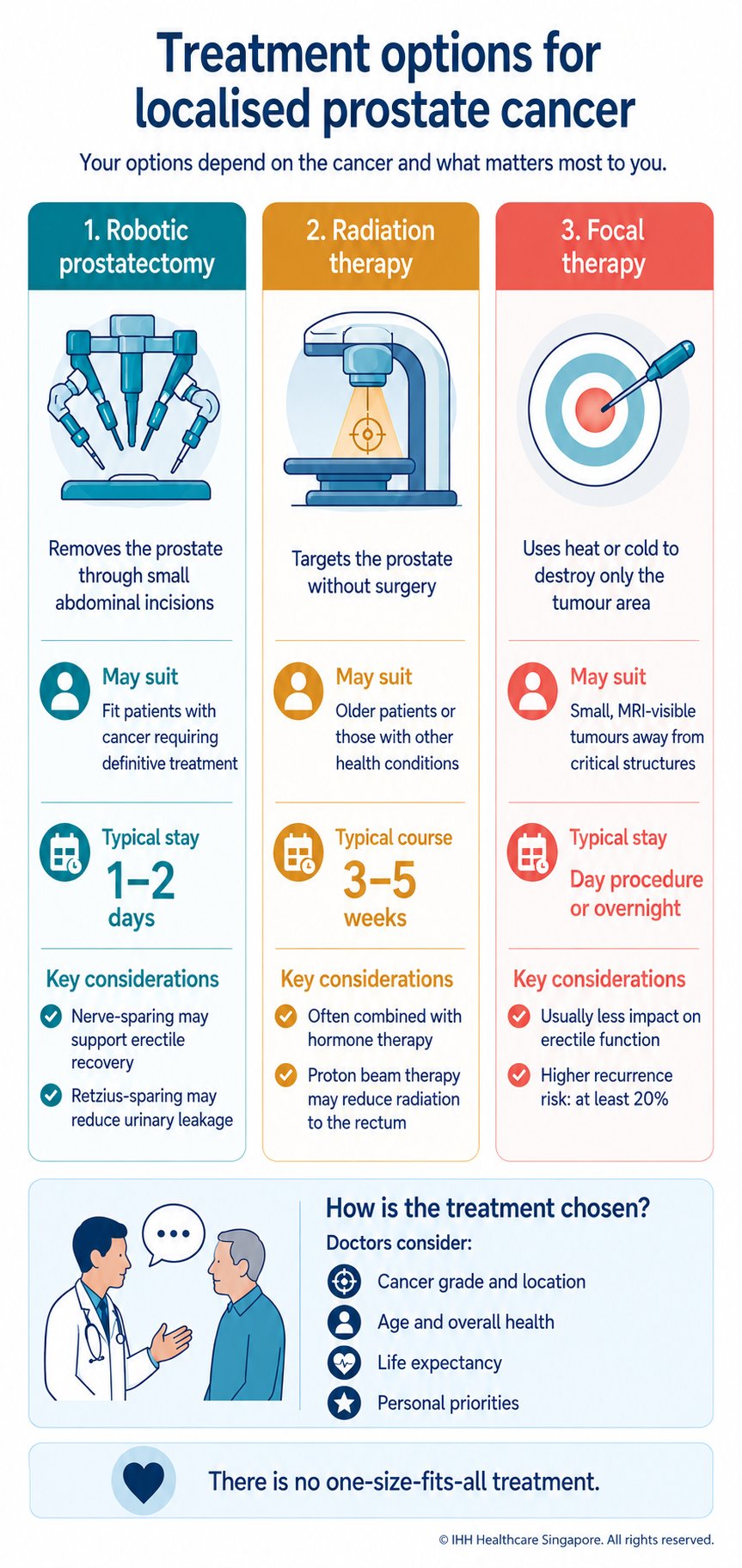
For localised prostate cancer that requires treatment, robotic prostatectomy – surgical removal of the prostate using a robotic system – is one of the main options. The surgery involves small incisions in the abdomen, through which a camera and robotic arms are inserted. The prostate is disconnected and removed, and the bladder and urethra are rejoined. Most patients go home after one to two days and need a catheter for a short period afterwards.
Two advances in surgical technique are worth knowing about:
The first is nerve sparing – because the nerves that control erection sit immediately adjacent to the prostate, we can, in suitable cases, carefully preserve them. This significantly improves the chances of erectile recovery after surgery, and we support this with a formal erectile function recovery protocol.
The second is what we call the Retzius-sparing approach – a modified surgical technique that preserves more of the supporting structures around the bladder, which substantially reduces the risk of urinary leakage. On the day of surgery using this approach, 20% of patients already have no leakage at all, and most patients have minimal issues by three months.
Radiation therapy is particularly well suited to patients who are older, or who have other health conditions that make surgery less ideal.
The latest form of radiation available is proton beam therapy, which delivers radiation with greater precision to the prostate and reduces the dose received by the surrounding rectum – a benefit because rectal side effects such as bleeding can be a complication of conventional radiation.
A course of radiation typically runs for 3 – 5 weeks. It is almost always combined with hormone injections – these block male hormones, effectively a temporary medical castration – for a minimum of 2 – 3 months before radiation begins and a further 6 months afterwards. The advantage is that there is no surgery; patients can largely continue their normal lives during treatment. Side effects can include some narrowing of the urinary tract, bladder irritation, and rectal discomfort, though most are mild. It is worth knowing that some radiation-related effects can emerge 5 – 10 years later, which is why life expectancy is a relevant consideration when choosing between surgery and radiation.
Focal therapy is an approach for patients whose cancer is small, visible on MRI, and not too close to critical structures. Rather than removing or irradiating the entire prostate, we target only the area where the cancer is. A needle is placed into the abnormal area and either cold (cryotherapy) or heat is applied to destroy the tumour. It is typically a day procedure or overnight stay, and recovery is generally straightforward.
The appeal of focal therapy is that the impact on erectile function is less significant than with surgery or radiation – most patients experience a temporary dip but not the more pronounced changes associated with whole-gland treatment. The tradeoff is that the recurrence rate is higher. For well-selected patients undergoing surgery or radiation, recurrence is roughly 20% or less.
With focal therapy, at least 20% of patients will experience a recurrence and may require repeat focal therapy or move on to definitive treatment. It is best understood as a treatment that may be curative for some patients, but for others will be a bridge to later intervention — particularly in older patients or those with slower-growing disease.
There is no single right answer – the decision is always a shared one between the patient and the doctor, taking into account the grade and location of the cancer, the patient's age, overall health, life expectancy, and personal priorities.
For example, a fit patient with a longer life expectancy and early-stage cancer might be best served by surgery, where the long-term recurrence data is strong and follow-up is straightforward – often just an annual PSA check. An older patient with other health conditions might be better suited to radiation. Someone with a very focal, well-defined lesion and specific concerns about side effects might be a candidate for focal therapy.
What matters most is that the decision is made with full information. The days of one-size-fits-all prostate cancer treatment are behind us – and that is a significant step forward for patients.
Prostate cancer caught early, while still localised to the prostate, has a 5 to 10-year survival rate of 97–99%; regular screening gives an 80% chance of catching it at this stage
PSA screening is recommended from age 50, or from 45 if you have a family history of prostate cancer or related cancers such as breast, pancreatic, or gastric cancer
An elevated PSA result does not automatically mean cancer; further tests including the PHI blood test and an MRI are usually done before a biopsy is considered
Not all prostate cancers require immediate treatment; grade group 1 cancers carry only a 2% chance of spreading over 15 years, and active surveillance is a safe and structured alternative to surgery or radiation for suitable patients
Treatment options today include robotic prostatectomy, radiation therapy, and focal therapy, and the right choice depends on the cancer's grade, location, and what matters most to the patient
Prostate cancer is one of more than a dozen cancers our specialists treat every day. Across medical oncology, urology, radiation oncology, haematology, and more, our cancer care team brings deep, multidisciplinary expertise to every diagnosis, so whatever you are facing, you are in experienced hands.
Learn more
A monthly breast self-examination 7 – 10 days after your period starts can save your life.

More women are being claimed by breast cancer now than before. Love them by encouraging them to go for breast screening.

Dr Tan Yah Yuen, general surgeon at Mount Elizabeth Hospitals, answers the questions you may have about mastectomies.

Dr Wee Siew Bock, breast surgeon at Mount Elizabeth Hospital, address your questions and concerns about breast conserving surgery (lumpectomy).

Dr Liau Kui Hin explains pancreatic neuroendocrine tumours (PNETs) and the newer, effective treatments for this uncommon cancer.

Dr Tan Yu-Meng, general surgeon at Mount Elizabeth Hospitals, gives us the stark facts about pancreatic cancer and the treatment options available for patients.

Our breast surgeon explains how to understand your risk, warning signs to know, why screening matters even when you feel well, and what surgery can look like today.

As knee osteoarthritis progresses, everyday activities can become more difficult. Our pain specialist and orthopaedic surgeon explain the treatment options available and how to find the right approach for you.

Dr Edwin Chng from Parkway Shenton explains why weight loss can slow down during medical weight management, and when it may be time to review your treatment plan.

Prostate cancer is common, often silent, and still diagnosed too late in Singapore. Urologist Dr Tan Yung Khan on what every man should know about screening, diagnosis, and treatment.

We answer common questions about haze, and how this can affect common chronic lung conditions such as asthma and chronic obstructive pulmonary disease (COPD), and 8 simple tips to protect ourselves against it.

Our neurosurgeon, Dr Vincent Ng, explains the factors specialists consider when deciding whether a brain aneurysm should be monitored or treated, and what the different treatment options involve.
Parkway East Hospital is part of IHH Healthcare, one of the world’s largest integrated healthcare networks.

Download the MyHealth360 app to access an array of medical services conveniently.


Get trusted medical advice from our specialists, dietitians and physiotherapists directly in your inbox.
Subscribe