



Kristine Xie
Family Physician


Source: Getty Images
 Add as a preferred source on Google
Family Physician
A multi-cancer early detection (MCED) test is a blood test that looks for signals of cancer in DNA fragments circulating in the bloodstream. MCED screening is offered through Executive Health Screeners centres at Mount Elizabeth Hospitals and Gleneagles Hospital, and can check for up to 50 cancer types from a single blood sample.
It is also offered at over 40 Parkway Shenton clinics, and Parkway MediCentre, in Singapore.
Dr Tan Min-Han, founder of the MCED test LucenceINSIGHT, says: “The 50 cancers covered in the test make up over 95% of all cancer cases. However, many of these 50 cancers such as lung cancer, liver cancer and pancreatic cancer, are not routinely screened for.”
MCED is designed to be used in addition to routine screening such as mammograms, colonoscopies, and gastroscopies, not instead of them.
MCED stands for multi-cancer early detection. It is a screening test that uses a blood sample to look for signs of several cancers at once, before symptoms appear. This sample is called a liquid biopsy.
Most screening tests look for one cancer at a time, such as a mammogram for breast cancer. An MCED test looks for signals associated with several cancers in a single blood sample.
The MCED test uses LucenceINSIGHT, developed by Lucence. Depending on the panel chosen, it screens for 6, 12 or up to 50 cancer types.
MCED is a screening test, not a diagnostic test. A positive result means further investigations are needed to find out whether cancer is present.
In an MCED test, blood is drawn in the same way as a standard blood test and sent to a laboratory for analysis.
Cancer cells shed altered DNA fragments into the bloodstream, known as circulating tumour DNA (ctDNA). The laboratory uses sequencing technology to detect these fragments, and computer analysis (machine learning) to predict which part of the body a cancer signal may have come from. Results are usually ready in about 15 – 18 working days.
An MCED test differs from familiar tumour marker tests such as CA19-9 or CA125, which measure proteins that cancer cells may make in higher amounts. Raised tumour markers do not always mean cancer, as some non-cancerous conditions can also raise them. MCED looks at genetic changes in DNA fragments instead.
Thus, MCED can detect signals of cancers such as breast, oesophagus, stomach, gastrointestinal stromal tumour (GIST), lung, bile duct, colorectal, nasopharyngeal, liver, pancreatic, cervical, and prostate cancer, among others.
The Singapore Cancer Registry Annual Report 2023 notes that 50 people in Singapore are diagnosed with cancer every day. It also notes that 1 in 4 Singapore residents may develop cancer by age 75.
The stage at which cancer is found makes a difference to outcomes. Cancer Research UK reports that in England, around 9 in 10 people with stage 1 bowel cancer live for at least 5 years after diagnosis, compared with around 1 in 10 people with stage 4 bowel cancer.
Routine screening in Singapore currently focuses on breast, cervical and colorectal cancer. Other cancers, such as pancreatic, liver, oesophagus, and stomach cancer, do not have a routine screening test recommended for the general population. This is where MCED tests may play a role.

Cancer is a growing health concern across Southeast Asia, and many cancers are found late.
In 2024, an estimated 474,083 people in Indonesia, 177,404 in Vietnam and 149,852 in the Philippines were diagnosed with cancer, according to the World Health Organization’s GLOBOCAN 2024 estimates.
Breast, lung and colorectal cancer are among the most diagnosed in all three countries. So is liver cancer, which, like pancreatic cancer, does not have a routine population screening test.
Indonesia: Without a change in strategy, the country’s National Cancer Plan 2024–2034 projects that cancer cases and deaths could rise by 63% between 2025 and 2040.
Vietnam: Liver and stomach cancer both rank in the top 5 by new cases, alongside breast, lung and colorectal cancer.
Philippines: Breast cancer makes up nearly 1 in 3 cancers in Filipino women. A 2022 review reported that about half of breast cancer patients (53%) and about 3 in 4 cervical cancer patients (75%) are diagnosed at an advanced stage.
Cancers found late are harder to treat, which is why finding them earlier matters. MCED is designed to be used alongside routine screening, not instead of it.
Travelling from Indonesia, Vietnam or the Philippines? See where to get an MCED test in Singapore below, or make an appointment by visiting our International Patients Guide.
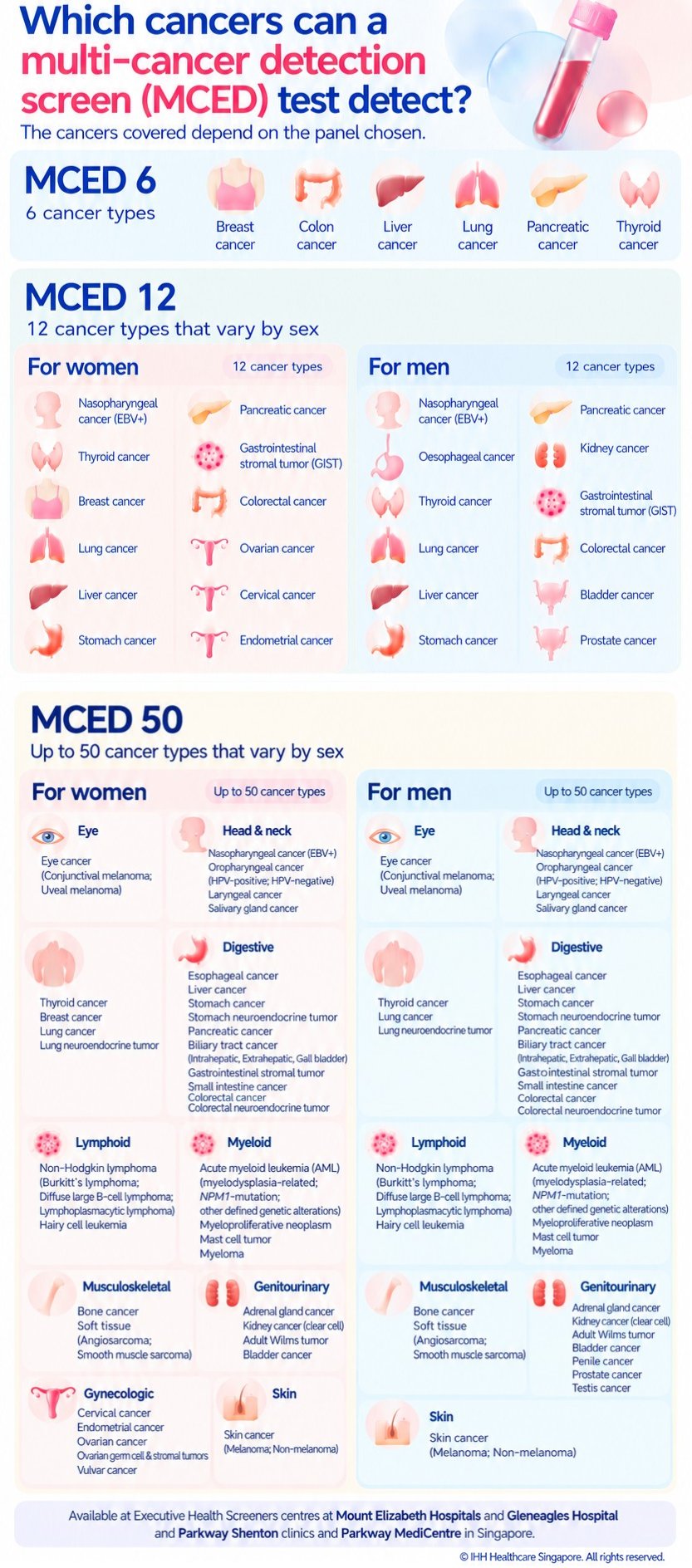
The cancers covered depend on the panel chosen:
MCED 6: breast, colon, liver, lung, pancreatic and thyroid cancer.
MCED 12: 12 cancer types including colorectal, liver, lung, nasopharyngeal, pancreatic, stomach, and thyroid cancer. Breast, cervical, endometrial and ovarian cancer are covered for women, and bladder, kidney, oesophageal and prostate cancer for men.
MCED 50: up to 50 cancer types. In addition to the cancers above, this includes blood and lymph cancers (such as lymphoma and leukaemia), skin and eye melanoma, head and neck cancers, bone and soft tissue sarcomas, and testis, penile and vulvar cancers.
MCED is recommended, together with existing screening tests such as mammograms and colonoscopies, and gastroscopies, for:
Screening needs vary with age, gender, medical history and risk factors, so speak to a doctor about whether MCED is suitable for you.
The Ministry of Health's National Population Health Survey 2022 found that close to 40% of women aged 50 to 69 had a mammogram in the previous 2 years, an example of how many people are not up to date with recommended screening.
“Over 6 in 10 Singaporean women choose not to go for their mammograms,” says Dr Tan. “And we also know that for colonoscopy, the compliance (to go for regular screening) is also not very high.”
“Tests such as the MCED make cancer screening accessible to people who may find traditional screening uncomfortable or inconvenient. It gives people an additional option.”
No. MCED does not replace routine cancer screening tests.
Tests such as mammograms, faecal immunochemical tests, colonoscopies and gastroscopies, are recommended according to age and risk, and each is designed to find a specific cancer. A colonoscopy and gastroscopy can also find and remove pre-cancerous polyps during the procedure.
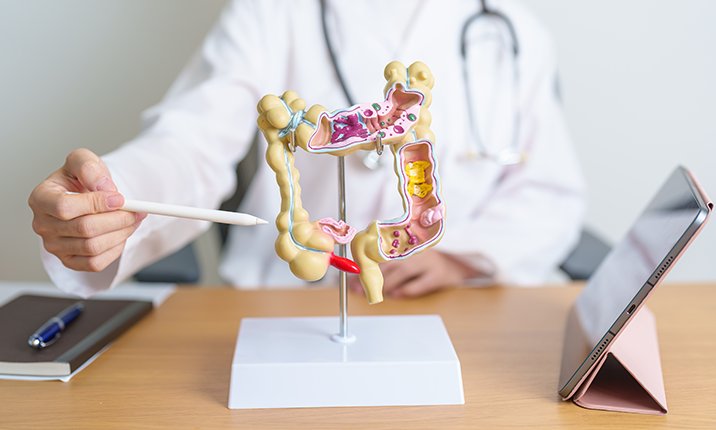
For example, adults aged 50 and above at average risk are recommended to start colorectal cancer screening, such as with a colonoscopy. An MCED test can be added alongside these screenings.
“The aim is not to replace tools that already work but to fill in the gaps where we currently aren't looking,” Dr Tan Min-Han says. “When used together, cancer marker tests and the MCED can help detect cancer earlier.”
Two measures describe how well a screening test performs:
In a validation study of LucenceINSIGHT reported in a conference abstract published in the Journal of Clinical Oncology in 2024, the test had a specificity of 99.0% and an overall sensitivity of 80.9%. The study compared blood samples from 313 healthy donors with samples from 288 people already diagnosed with cancer, so results in a routine screening population may differ.
“Mammograms have a specificity of 92%,” says Dr Tan Min-Han. “That means that 8 in 100 women receive a false positive result.”
The availability of the MCED marks a significant advancement in the way cancer screening is done. It promises a future where such screenings are as straightforward and routine as a standard blood test.
Dr Tan shares: “Cancer can be frightening but at the same time, because it is curable if diagnosed at an earlier stage, I think there is good reason for hope."
Parkway Shenton clinics offer cancer screening packages, while Parkway MediCentre provides MCED testing as part of its health screening packages. MCED testing is also available at Executive Health Screeners clinics at Mount Elizabeth Hospitals and Gleneagles Hospital.
Travelling from Indonesia, Vietnam or the Philippines? Your blood sample can be collected during your visit to Singapore, with results typically ready in 15–18 working days. Our International Patients Guide can help with appointment coordination, while our international patient team can explain how your results will be reviewed with a doctor after you return home.
Mount Elizabeth Hospitals and Gleneagles Hospital
Executive Health Screeners: +65 6280 0090
Indonesia: +62 812 8375 7583
Philippines: +63 917 635 7156
Other countries: Visit our International Patients Guide
Dr Kristine Xie, family physician at Parkway Shenton, answers commonly asked questions about the multi-screen cancer detection screen (MCED).

MCED stands for multi-cancer early detection. It refers to blood tests that screen for signals of several types of cancer at the same time, before symptoms appear.
Yes. An MCED test looks for signals associated with several cancers in a single blood sample. A positive result does not confirm cancer; further tests are needed to find out whether cancer is present and where.
Cancer screening is testing people who have no symptoms to find cancer or pre-cancerous changes, at an early stage when treatment tends to work better. Common examples include mammograms for breast cancer, Pap smears and HPV tests for cervical cancer and faecal immunochemical tests or colonoscopies for colorectal cancer. Screening does not diagnose cancer. An abnormal result needs further tests to confirm.
In a validation study of LucenceINSIGHT, the test had a specificity of 99.0% (correctly returning a negative result in people without cancer) and an overall sensitivity of 80.9% (detecting cancer in people who had it).
Sensitivity is higher for later-stage cancers and varies by cancer type. A negative MCED result is reassuring but cannot rule out cancer on its own. It is designed to complement, not replace, your existing screening tests, and your doctor will interpret it alongside your full clinical picture. A positive result needs confirmation through further tests.
At Parkway Shenton and Parkway MediCentre, MCED 6 costs S$654, MCED 12 costs S$1,999 and MCED 50 costs S$3,999, including GST (as of October 2026). A consultation fee may apply. Check the Parkway Shenton or Parkway MediCentre website, or call, for current pricing.
The blood draw is the same as a standard blood test, with a brief sting from the needle. There is no scope, bowel preparation or radiation involved.
MCED may be considered, in addition to existing screening tests, for individuals aged 40 and above without a personal history of cancer, and for individuals with an elevated cancer risk, such as a family history of cancer. The decision to undergo MCED screening should be made in consultation with your doctor, taking into account your personal risk factors and the limitations of the test.
Results are usually ready about 15 – 18 working days after the blood sample is taken.
A positive result means a cancer signal was detected. It does not confirm cancer. Your doctor will review the result with you and may recommend further tests, such as imaging, an endoscopy or a biopsy, to find out whether cancer is present and where it may be.
Yes. We welcome overseas patients to go for an MCED test through Executive Health Screeners centres at Mount Elizabeth Hospitals and Gleneagles Hospital. For regional visitors, please visit our International Patients Guide for help with arranging an appointment.
The MCED test is also available at Executive Health Screeners centres at over 40+ Parkway Shenton clinics and Parkway MediCentre in Singapore. For residents living in Singapore, please contact Parkway Shenton (WhatsApp: +65 8660 0090) or Parkway MediCentre (WhatsApp: +65 9177 9045) for an appointment.
Patients are required to travel to Singapore for the blood draw as the laboratory testing facility is based in Singapore. Having the blood sample collected locally helps ensure that it is handled, processed, and delivered to the laboratory within the required timeframe and under the appropriate conditions to maintain sample integrity and ensure accurate test results.

A monthly breast self-examination 7 – 10 days after your period starts can save your life.

More women are being claimed by breast cancer now than before. Love them by encouraging them to go for breast screening.

Dr Tan Yah Yuen, general surgeon at Mount Elizabeth Hospitals, answers the questions you may have about mastectomies.

Dr Wee Siew Bock, breast surgeon at Mount Elizabeth Hospital, address your questions and concerns about breast conserving surgery (lumpectomy).

Dr Liau Kui Hin explains pancreatic neuroendocrine tumours (PNETs) and the newer, effective treatments for this uncommon cancer.

Dr Tan Yu-Meng, general surgeon at Mount Elizabeth Hospitals, gives us the stark facts about pancreatic cancer and the treatment options available for patients.

Our breast surgeon explains how to understand your risk, warning signs to know, why screening matters even when you feel well, and what surgery can look like today.

As knee osteoarthritis progresses, everyday activities can become more difficult. Our pain specialist and orthopaedic surgeon explain the treatment options available and how to find the right approach for you.

Dr Edwin Chng from Parkway Shenton explains why weight loss can slow down during medical weight management, and when it may be time to review your treatment plan.

Prostate cancer is common, often silent, and still diagnosed too late in Singapore. Urologist Dr Tan Yung Khan on what every man should know about screening, diagnosis, and treatment.

We answer common questions about haze, and how this can affect common chronic lung conditions such as asthma and chronic obstructive pulmonary disease (COPD), and 8 simple tips to protect ourselves against it.

Our neurosurgeon, Dr Vincent Ng, explains the factors specialists consider when deciding whether a brain aneurysm should be monitored or treated, and what the different treatment options involve.
Parkway East Hospital is part of IHH Healthcare, one of the world’s largest integrated healthcare networks.

Download the MyHealth360 app to access an array of medical services conveniently.


Get trusted medical advice from our specialists, dietitians and physiotherapists directly in your inbox.
Subscribe